
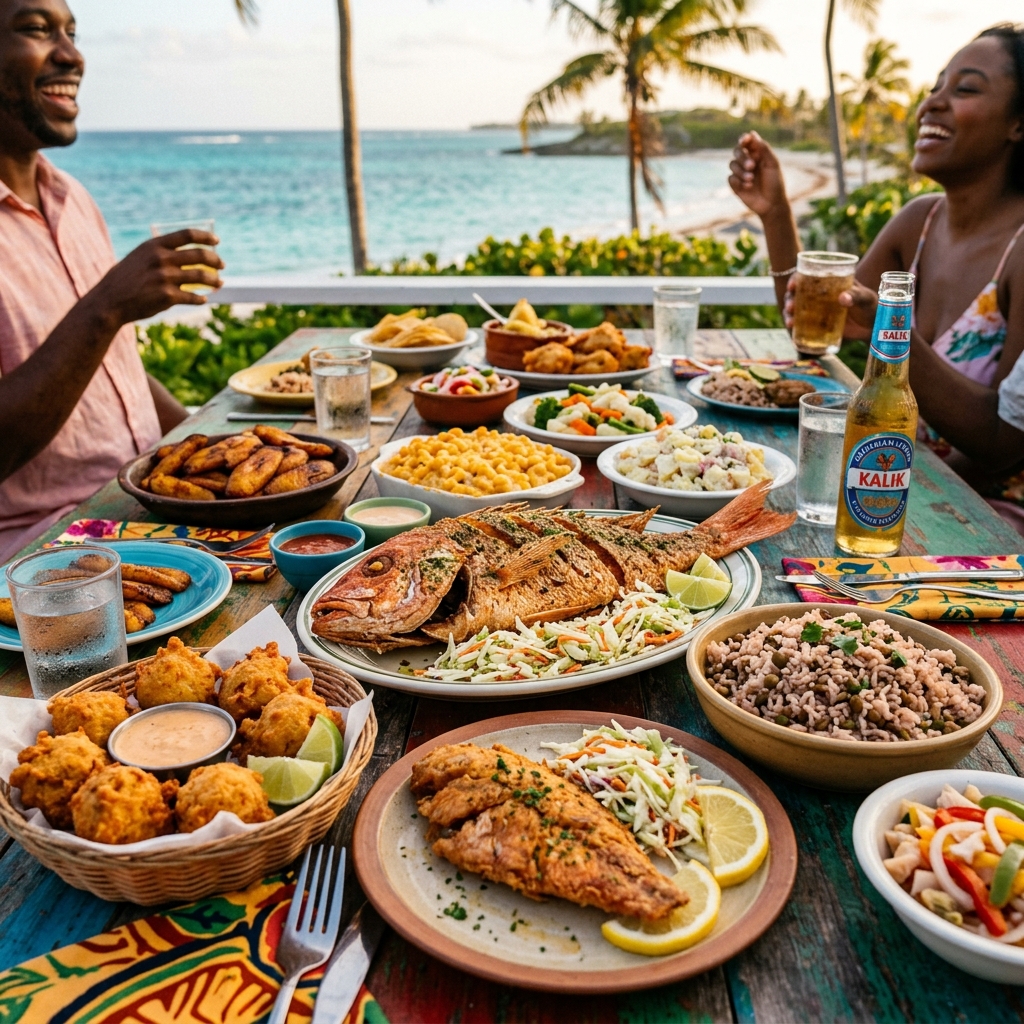
Bahamian food tastes like nowhere else in the Caribbean. Understanding why requires understanding where it came from — a specific convergence of West African cooking traditions, British colonial provisioning, the remarkable marine environment of the shallow Bahamian banks, and several hundred years of relative geographic isolation that allowed the cuisine to develop on its own terms.
The West African Foundation
The most important influence on Bahamian cuisine is West African cooking practice, brought to the Bahamas by enslaved Africans who constituted the majority of the Bahamian population by the early 19th century. The specific techniques and ingredients they brought — and adapted to what was available in the Bahamas — shaped the foundational structure of Bahamian food in ways that are still visible today.
Peas and rice — the Bahamian starch of record — is a direct descendant of West African rice and legume traditions, adapted to local ingredients (pigeon peas rather than black-eyed peas, Bahamian spices rather than West African ones) over generations. The technique of seasoning a cooking liquid and using it to flavour the starch, rather than serving starch plain alongside a sauce, is distinctly West African in origin.
The use of whole fish in cooking — boil fish, stew fish — reflects West African fishing community traditions where nothing from a catch is wasted. The spice profile of Bahamian food, which uses goat pepper and bird pepper as aromatic elements rather than aggressive heat sources, echoes West African approaches to chilli use.
The British Colonial Overlay
British colonial influence on Bahamian food is most visible in what was imported and institutionalised: the gin that forms the base of Sky Juice rather than rum (rum being associated with French and Dutch Caribbean islands more than British ones in the early colonial period), the johnnycake's relationship to British cornmeal bread traditions, and the Sunday roast influences that persist in Bahamian home cooking in ways that are not visible in the tourist-facing food landscape.
The colonial period also determined what was available in Nassau's markets — which shaped what Bahamian cooks worked with — through the patterns of trade and provisioning that connected the Bahamas to Britain, North America, and the wider Caribbean economy.
The Marine Environment
The Bahamas sits on one of the world's largest shallow-water carbonate platforms. The Bahamian Banks — the shallow seas covering most of the archipelago — create an environment of extraordinary biological productivity. Conch, grouper, snapper, spiny lobster, and crab are not Caribbean food generics here; they are what is literally abundant in the surrounding water.
The conch salad tradition — raw conch, freshly prepared, with citrus and pepper — is the most direct expression of this marine proximity. It requires no cooking because the freshness of the ingredient makes cooking an unnecessary step. You cannot make conch salad at the level it is made in Nassau with conch that was not alive this morning. The dish encodes the proximity of the Bahamian sea in every preparation.
What to Eat to Understand It
The three dishes that most directly express Bahamian food culture are:
- Conch salad at Arawak Cay Fish Fry — the West African-influenced fresh preparation technique applied to the defining Bahamian marine ingredient.
- Boil fish with johnnycake — the traditional Bahamian breakfast that most directly expresses the West African fish-broth tradition adapted to Bahamian circumstances.
- Peas and rice alongside grilled whole snapper — the complete Bahamian main course, representing every major influence in the cuisine simultaneously.
The Grill Hut in the cruise port area handles the accessible versions of these reliably. Blue Marlin takes the seafood elements seriously in a more elevated context. Arawak Cay is the right setting for the first two, as it has been for generations of Nassau residents.
