
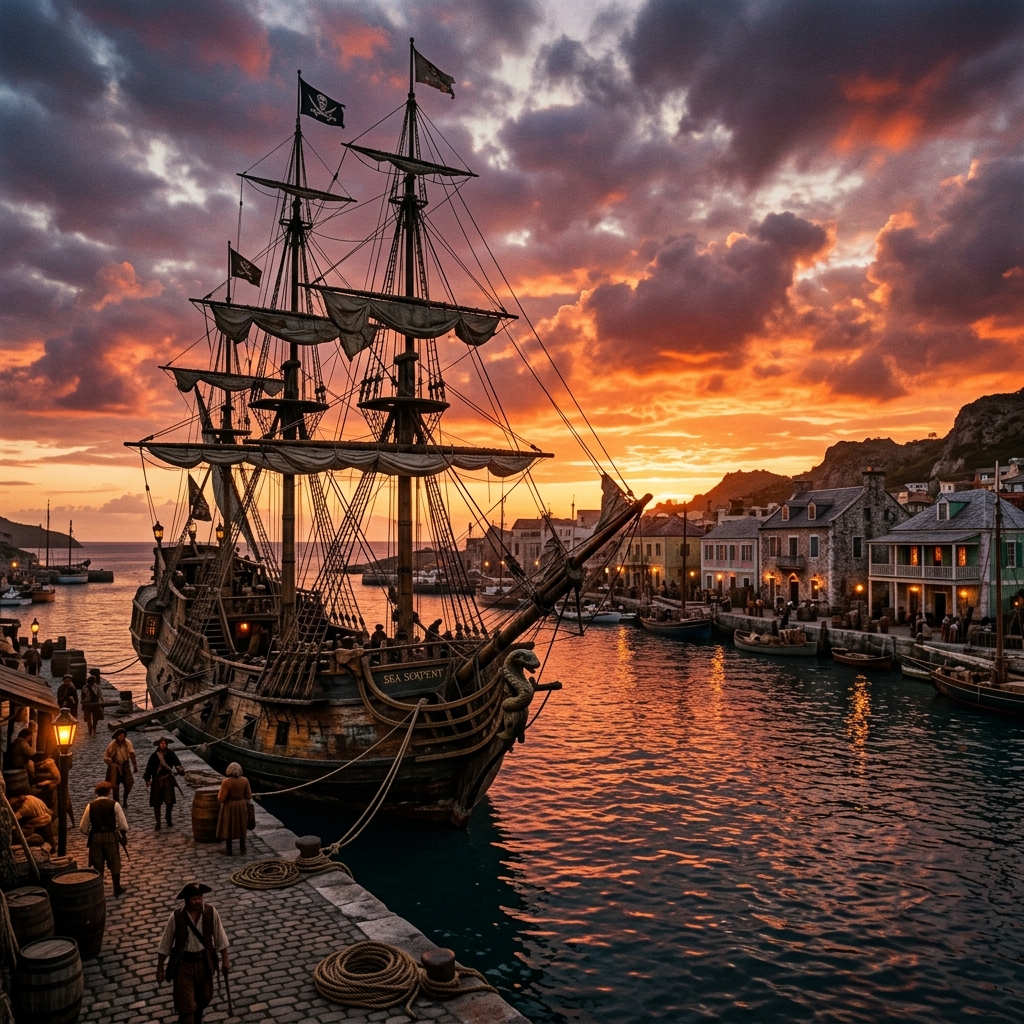
Nassau's pirate history is both more extraordinary and more serious than the tourist industry version suggests. Between roughly 1706 and 1718, Nassau was not just a place where pirates happened to stop — it was effectively governed by a loose confederation of pirates who had, in practice, created a self-organised alternative society operating on principles that challenged the social and economic hierarchies of the legitimate world.
How Nassau Became a Pirate Republic
The Bahamas had been a contested and frequently depopulated colonial territory through the late 17th century. The War of Spanish Succession (1701–1714) generated a large population of privateers — licensed pirates operating under letters of marque from various European governments — who lost their employment when the war ended. Many of them drifted to Nassau, where the harbour provided shelter, the island provided fresh water and food, and the British colonial authority was essentially absent.
By around 1706, Nassau had become a de facto pirate base. By 1713–1714, it was something more structured: a community of several hundred pirates operating from the same location, sharing intelligence about shipping lanes, trading supplies and information, and developing informal norms for the distribution of plunder. Historians have called this the "Republic of Pirates" — not because it was formally constituted as a republic, but because it operated on broadly egalitarian principles by the standards of its era.
The Key Figures
Benjamin Hornigold was the closest thing the Nassau pirate community had to a founding figure — one of the first significant pirates to establish himself in Nassau after the War of Spanish Succession, and the man who mentored several of the pirates who became more famous than he did.
Edward Teach — "Blackbeard" — is the most mythologised figure from the Nassau pirate period, and his reputation was partially constructed by himself as a psychological weapon. He was genuinely dangerous and genuinely effective as a pirate, but the elaborate stagecraft of the burning hemp in his beard was performance calculated to maximise the surrender of ships without fighting. He operated from Nassau during the peak pirate period.
Anne Bonny and Mary Read are the most famous women in Nassau's pirate history. Both served as crew members on pirate vessels operating from Nassau and the Bahamian waters — in an era when women serving as combatants was essentially unprecedented in legitimate society. Their presence on pirate crews is evidence of the degree to which pirate society inverted the hierarchies of the legitimate world.
Calico Jack Rackham commanded the vessel on which Bonny and Read served. He is less remembered for his own piracy than for his association with these two women and for the manner of his capture — reportedly drunk when taken by pirate hunters, while Bonny and Read fought on.
The End: Woodes Rogers
In 1718, the British Crown sent Woodes Rogers as the first Royal Governor of the Bahamas with a mandate to end the pirate republic. He arrived with a fleet, offered a royal pardon to any pirate who surrendered and renounced piracy, and executed those who refused or who returned to piracy after accepting the pardon.
The motto Rogers adopted for the Bahamas — "Expulsis Piratis Restituta Commercia" (Pirates expelled, commerce restored) — survives on the Bahamian coat of arms today. The speed with which the pirate republic ended, once a competent governor arrived with adequate force, suggests that its governance was always more fragile than its mythology implies.
What It Left Behind
The pirate period left Nassau three things: a mythology that has been commercially exploited ever since, a genuine historical record that is more interesting than the mythology, and a strain of Bahamian self-identification that connects the republic's anti-hierarchical energy to later movements for Bahamian independence and political equality.
The Pirates of Nassau Museum on King Street in downtown Nassau is the best place to engage with the history directly — well-presented, historically informed, and worth the admission for anyone who wants more than the bar-themed version of the pirate story that dominates Bay Street tourism.
