
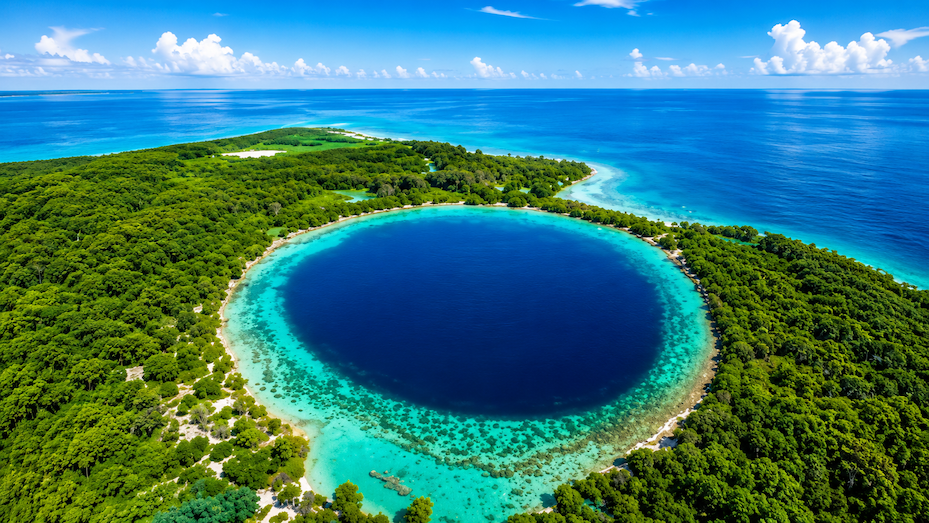
The Bahamas is a country built on shallow water. Its sandbars, reef flats, and turquoise channels rarely reach more than a few meters deep, and that is most of what visitors see. But scattered across the islands — and concentrated on Andros in numbers that exist nowhere else on earth — are blue holes: vertical shafts of dark water that drop straight down through the limestone floor, past the reach of daylight, into cave systems that have not been fully explored. They are some of the most extraordinary natural formations in the Western Hemisphere, and the culture of the islands has been shaped by the long shadow of their mystery.
Andros: The Blue Hole Capital of the World
Andros Island contains more blue holes than anywhere else on the planet — 175 documented inland blue holes and approximately 50 offshore, a total of around 200. No other place on earth comes close. The Blue Holes National Park on North Andros protects a portion of the most significant inland formations, and the offshore holes are a primary destination for the technical divers and scientists who come to Andros specifically to study what lives below.
How They Formed
The blue holes are a geological record of the Ice Age. Between 2.6 million and 11,700 years ago, sea levels across the Caribbean were up to 120 meters lower than they are today — the Bahamian limestone platform was dry land. Slightly acidic rainwater slowly dissolved the rock from above, carving out underground cave systems across the islands. When the last Ice Age ended and glaciers melted, sea levels rose and flooded those caves, leaving the shafts open at the surface as circles of impossibly dark blue water against the surrounding pale turquoise. What you see when you look into a blue hole is a flooded cave that the Ice Age built.
Dean's Blue Hole
The deepest blue hole accessible in the Bahamas is Dean's Blue Hole on Long Island, near Clarence Town on the island's western shore. It descends 202 meters — its entrance is a narrow shaft that opens into a wide chamber below the surface, like an inverted bell, and the walls disappear into darkness well before the bottom. Dean's is one of the deepest blue holes on earth, and it holds some of freediving's most significant records: in 2010, New Zealander William Trubridge descended 92 meters on a single breath without fins, setting a world record that stood for years. The Bahamas Tourism Authority describes Dean's Blue Hole as one of the natural wonders of the country. For the serious freediver, it is a pilgrimage site.
The Lusca
On Andros, the blue holes have always been inhabited — at least in the imagination of the people who live near them. The Lusca is the creature of the holes: half shark, half octopus, with the speed and teeth of a predator and the reach of many powerful arms. According to Andros folklore, the Lusca pulls swimmers and fishermen down through the shaft when the tidal currents surge through the holes — a real phenomenon, since many blue holes are connected to the sea and pulse with the tide. Marine biologists who have studied the unique bacteria and organisms found in Andros's blue holes note that the chemical layers in some holes genuinely support life found nowhere else on earth. The Lusca may be mythology, but the blue holes are strange enough to have earned it.
For the maritime culture that has grown around the Bahamian sea more broadly, that island-life guide covers the sailing traditions that connect the islands. And for anyone planning time on Long Island specifically, the Long Island Bahamas guide covers everything the island offers beyond its most famous hole.
