
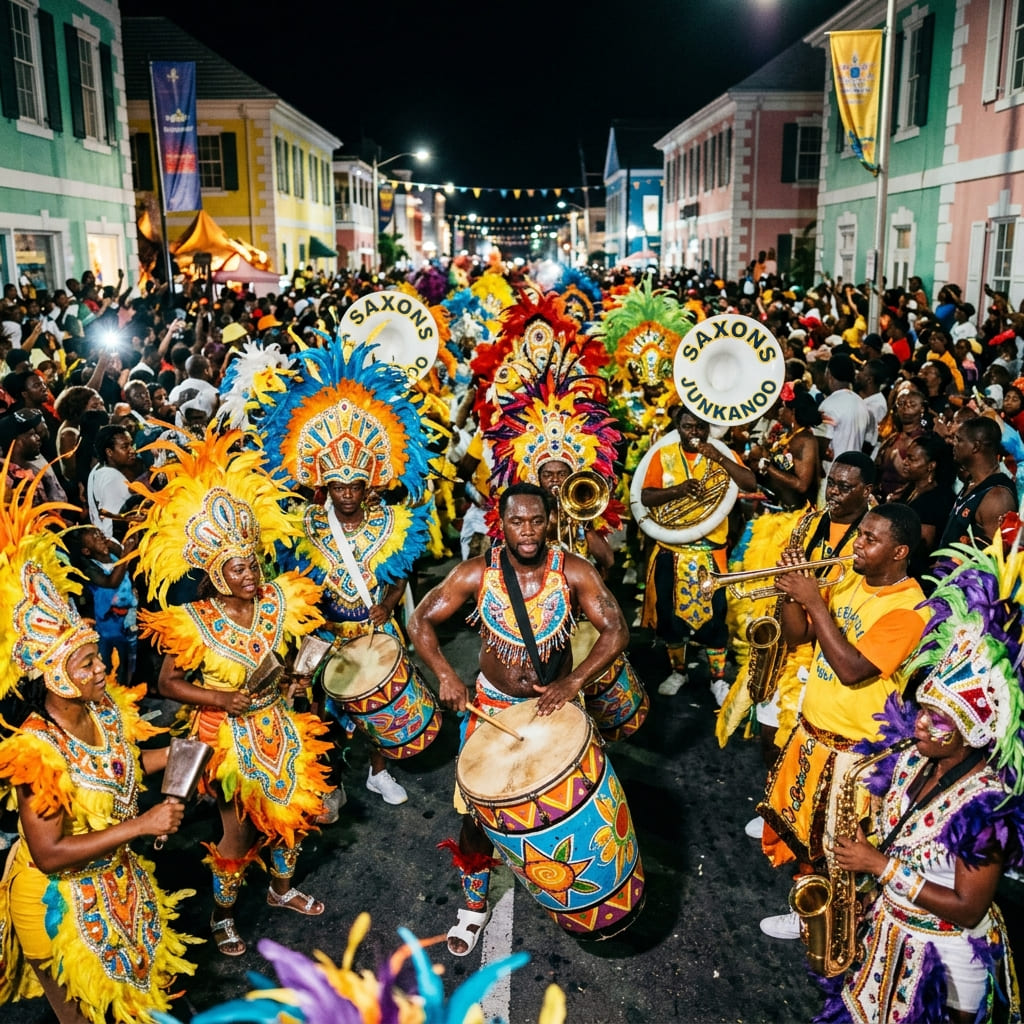
If you've been to Nassau during Junkanoo season, you've heard it before you've seen it. The cowbells begin, then the drums, then the brass horns — building into a wall of rhythm that has no precise equivalent anywhere else in the Caribbean. Then the costumes appear: elaborate, hand-crafted constructions of crepe paper, cardboard, and fabric that take months to build and are worn for hours through the streets of downtown Nassau in the early hours of the morning.
Junkanoo is many things simultaneously: a festival, a competition, a cultural archive, a community practice, and the most distinctively Bahamian thing that exists. Understanding it properly changes how you see Nassau.
The Origins
Junkanoo's origins are debated, but the most widely accepted account traces it to the era of slavery in the Bahamas. Enslaved Bahamians were given time off during the Christmas period — Boxing Day and New Year's Day — and used those hours to gather, make music, wear masks, and celebrate in ways that drew on West African cultural traditions while existing just within the tolerance of colonial authority.
The name itself is disputed. Some historians connect it to "John Canoe," a West African chieftain whose spirit was celebrated in dance. Others trace it to French or English colonial terminology. The Bahamian government formally recognizes Junkanoo as a cultural heritage practice, and its continuation through generations from slavery to the present day is one of the more remarkable examples of cultural persistence in the Caribbean.
The Structure of Junkanoo
Modern Junkanoo is organized around competing groups — the Valley Boys, the Saxons Superstars, the Music Makers, and several others — who prepare year-round for the main parades. The competition is scored on costume construction, music, and choreography. The stakes, within Nassau's cultural context, are significant. Winning the Boxing Day or New Year's Junkanoo parade is a serious civic achievement.
The main parades happen on Boxing Day (December 26) beginning around 2am and running through dawn, and again on New Year's Day (January 1) in the same format. The overnight timing is deliberate — it connects to the historical pattern of the festival and creates an atmosphere that a daytime parade could not replicate.
Viewing stands are erected along Bay Street for the main parades. Positions close to the judging areas are the most sought-after. Tickets sell in advance and go quickly for the main events — if you're planning to visit Nassau specifically for Junkanoo, book accommodation and stands tickets months ahead.
The Costumes
The costumes are where the year-round preparation becomes visible. Groups begin construction months before the parade, working in "shacks" — the workshops where costumes are built, strategies are planned, and music is rehearsed. The construction uses crepe paper applied over cardboard and wire armatures in patterns of extraordinary complexity and colour.
The largest costumes — the "floats" that individual performers carry or wear — can be several meters tall and weigh significant amounts. The people wearing them dance and move through hours of parade while maintaining the choreography their group has rehearsed. The physical endurance required is considerable.
Experiencing Junkanoo Outside of December and January
If you're visiting Nassau outside the main parade season, Junkanoo is still accessible:
- The Junkanoo Museum in downtown Nassau houses historic costumes and provides context on the festival's history and construction techniques.
- Several Nassau venues offer Junkanoo cultural experiences for visitors year-round — live demonstrations of the music and costume work.
- The Junkanoo Summer Festival, which runs in Nassau during the summer months, offers a less intense but accessible version of the parade experience.
- If you're in Nassau on a day when groups are rehearsing — which happens year-round in various forms — you may hear the music from a shack somewhere in the city. This is not a tourist experience; it's rehearsal. Treat it accordingly.
Why It Matters
Junkanoo is the clearest evidence that Bahamian culture is not simply a Caribbean tourism product — it's a living practice with specific historical roots, community investment, and creative ambition. Nassau is a city where people prepare for months for a parade that happens in the middle of the night on two specific mornings a year, and treat the result with the seriousness of a major competitive event.
That context changes the texture of visiting Nassau. The city is not just a cruise port with good beaches. It's a place with a cultural life that exists entirely on its own terms, mostly at hours when tourists are asleep.
