
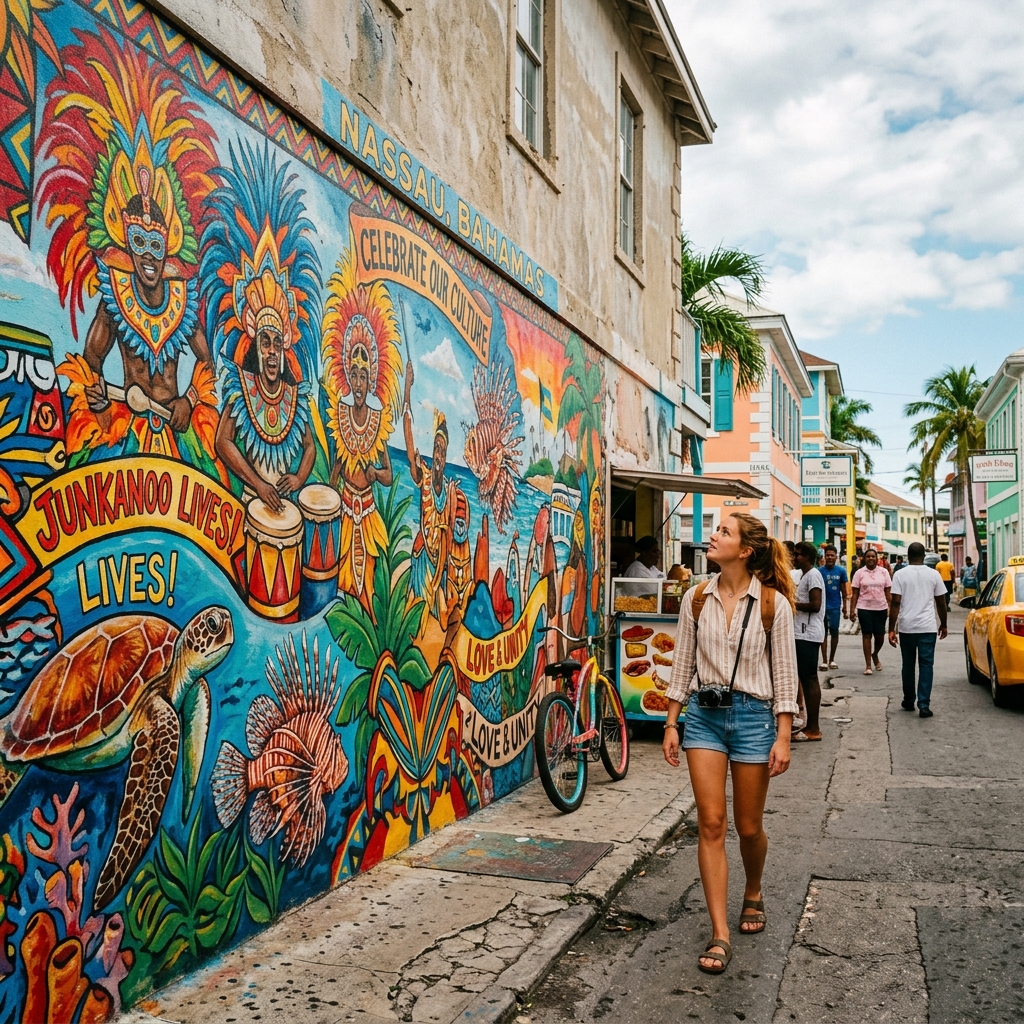
Nassau's street art is not concentrated in a single instagrammable alley designed for tourism. It is distributed across the residential and commercial neighbourhoods of the city in the way that genuine urban art is distributed — where someone had a wall, had something to say, and had the skill to say it visibly. Finding it requires walking slightly further from the cruise port than most visitor guides recommend, but the walk itself gives you a Nassau that the port area cannot provide.
The Over-the-Hill Neighbourhood
Over-the-Hill is Nassau's oldest established Black Bahamian neighbourhood, sitting on the ridge immediately south of the historical centre. The name is literal — you go over the ridge from the colonial town above the harbour and descend into a denser, more residential Nassau that has been the heart of Black Bahamian community life since the post-emancipation period.
Over-the-Hill has the most concentrated street art in Nassau — murals depicting Junkanoo figures, Bahamian historical scenes, portraits of community figures, and abstract work that reflects the neighbourhood's identity as a place that knows its own history. The work ranges from small wall pieces to building-scale murals on Grant's Town side streets.
This is a residential neighbourhood, not a tourist attraction. Visit respectfully, during daylight hours, with the same awareness you would bring to any unfamiliar neighbourhood in any city. The street art is publicly visible — you do not need to enter private spaces to see it.
The Downtown Murals
The historical centre and Bay Street area have accumulated a series of murals on the sides of commercial buildings and on infrastructure walls that depict Nassau's colonial and post-independence history. The Woodes Rogers Walk area near the cruise terminal has pieces that reference the pirate republic period. The streets behind Parliament Square have work that depicts the independence movement and figures from Bahamian political history.
These pieces are easier to find than the Over-the-Hill work and are within the 15-minute walking radius of the cruise terminal. Start at Parliament Square, walk south toward Grant's Town, and look at walls rather than shop fronts.
The Junkanoo Iconography
The most visually distinctive element of Nassau street art is the recurrence of Junkanoo imagery — the elaborate costumes, the masked figures, the cowbell and drum iconography — as a visual language for Bahamian cultural identity. Junkanoo appears not just as a festival subject but as a recurring motif expressing what is specifically Bahamian about this place and its people.
Understanding what Junkanoo is before you encounter it in the street art makes the visual language legible. See our Junkanoo explainer for the full cultural context.
Practical Walking Notes
- The Over-the-Hill walk from the cruise terminal is approximately 20–25 minutes on foot, heading south over the ridge from Parliament Square.
- Morning light is the best time for photographing murals — the harsh midday sun bleaches the colour and creates difficult contrast.
- Ask locals about recent additions — Nassau's street art scene is active and new pieces appear regularly.
- Several Nassau street art tours operate informally — local photographers and guides who know where the best work is and the stories behind it. Worth finding if you have more than one day in Nassau.
