
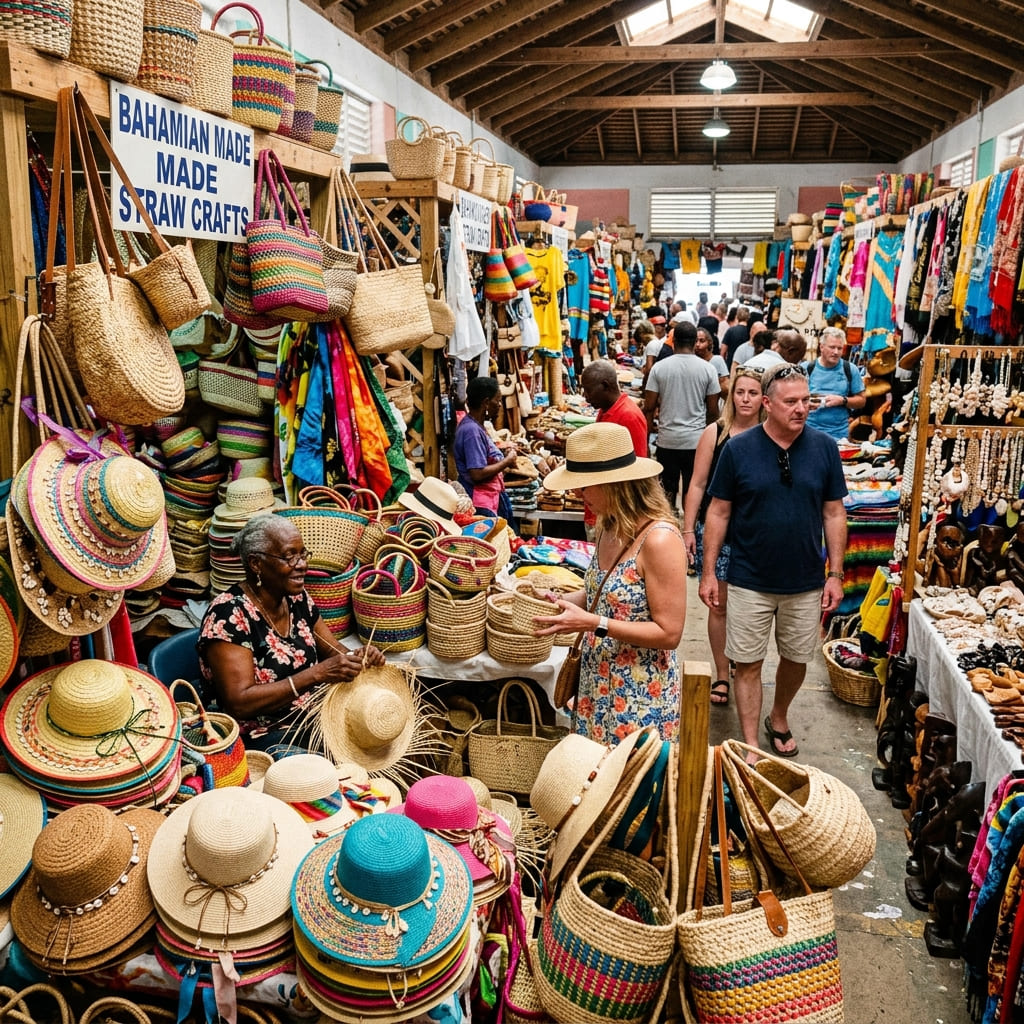
The Nassau Straw Market on Bay Street is impossible to miss and, for many cruise guests, one of the first stops after leaving the port. It's a large covered market of several hundred stalls selling Bahamian crafts, woven goods, jewellery, clothing, and souvenirs. It is also a market where a significant portion of what's sold is not made in the Bahamas.
Here's how to navigate it honestly.
What the Straw Market Is
The current market building replaced the original structure that burned down in 2001. It's a purpose-built tourist market on Bay Street, adjacent to the waterfront, within easy walking distance of the cruise port. It is staffed predominantly by Bahamian vendors, but the merchandise they sell ranges from genuinely handmade local crafts to mass-produced imports with Bahamas branding applied.
The "straw" in the name refers to the traditional Bahamian craft of weaving items from dried palm fronds and other plant materials — a genuine art form that was the original basis of the market. Authentic straw work is still sold there, but it is a minority of the total merchandise.
What's Worth Buying
Genuine woven straw goods — baskets, hats, bags made from palm frond — are the most authentically Bahamian items in the market. Ask the vendor where it was made and watch their response. Locally made straw work is typically irregular in a way that machine-made goods are not; the weave has personality.
Wood carvings from local artists — look for pieces that are clearly handmade rather than uniform. Ask about the artist.
Locally made hot sauce, rum cake, and Bahamian food products — these are reliable authentic purchases. Bahamas rum cake, in particular, is a legitimate local product that travels well and makes a good gift.
Conch shell items — with the caveat mentioned below about sustainability.
What to Skip
T-shirts with Bahamas branding that were manufactured in Guatemala or Bangladesh. Trinkets stamped with "Nassau, Bahamas" that have never been within 1,000 miles of New Providence. Jewellery that is identical to jewellery available in every Caribbean cruise port market from Cozumel to St. Thomas.
None of these are uniquely bad compared to souvenir markets elsewhere in the Caribbean — this is simply the reality of how mass-market tourist souvenirs work globally. If the provenance matters to you, ask and look for handmade irregularity. If it doesn't, buy what you like.
On Conch Shells
Conch shells are sold throughout the Straw Market and are a visually appealing Bahamian souvenir. The sustainability situation is complicated: queen conch is a protected species in the Bahamas, and shells from legally harvested conch (a byproduct of the food industry) are permitted for sale. Shells imported from countries without harvest regulations are also present in the market and are harder to distinguish.
If you're buying a conch shell, ask where it was harvested. A vendor who knows it came from Bahamian waters should be able to tell you.
How to Negotiate
Prices in the Straw Market are not fixed. Opening prices are set with negotiation in mind — most vendors expect a counter-offer and factor it into their initial quote. A reasonable approach:
- Express interest without urgency. Don't say "I love this, I have to have it."
- Counter at roughly 60–70% of the asking price for a starting point.
- Be friendly throughout — the negotiation is a social interaction, not a confrontation.
- Walking away often generates a better offer. If it doesn't, you've established a real floor price.
- Buying multiple items from one vendor gives you more leverage to negotiate a combined price.
Don't be aggressive or dismissive. The vendors in the Straw Market are running small businesses in a competitive environment. Respectful negotiation is expected and welcomed. Rudeness is not.
Practical Logistics
- The market is open daily, with more vendors present on mornings when cruise ships are in port.
- It gets crowded and warm inside during peak hours — early morning and late afternoon are more comfortable times to visit.
- USD is accepted everywhere; exact change is helpful for small purchases.
- Leave your passport on the ship and carry only what cash you plan to spend.
The Nassau Straw Market is worth seeing even if you don't buy anything — it's a genuine piece of Nassau's commercial and cultural life, and the vendors are, for the most part, excellent company. Go with reasonable expectations, look for the handmade, and negotiate cheerfully.
