
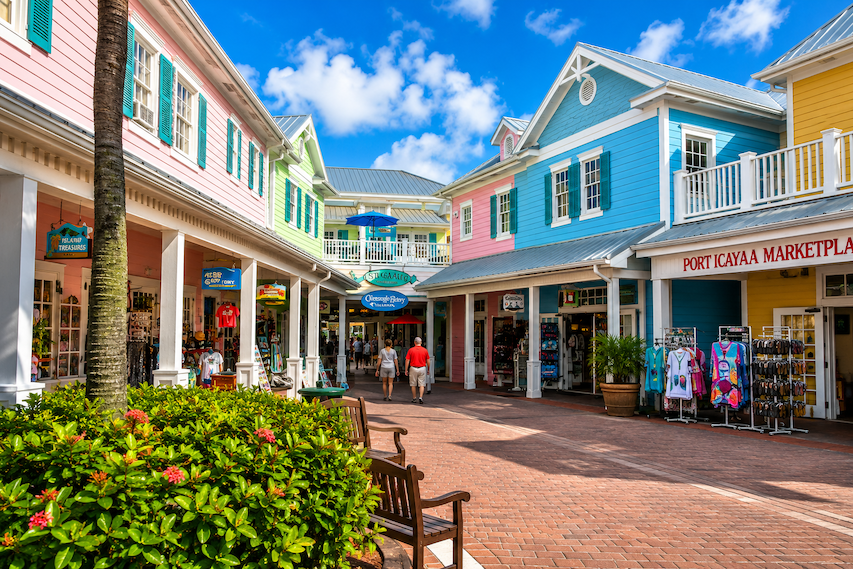
The Bahamas is an archipelago of more than 700 islands, and the two most visited by cruise passengers — Nassau and Grand Bahama — offer experiences so different from each other that choosing one shapes the entire tone of your trip. Nassau is the country's capital, its most layered city, and its most concentrated mix of history, culture, and resort life. Grand Bahama is the quieter island: more nature, fewer crowds, and a pace that feels closer to how the Bahamas existed before the big resorts arrived. Both are genuinely worth knowing.
Nassau — The Bahamas in Full Color
Founded in 1670, Nassau carries three and a half centuries of history in its architecture, its neighborhoods, and its street life. The colonial buildings along Bay Street, the Queen's Staircase carved into limestone in 1793, Parliament Square, and the pastel-painted downtown deliver a walking experience that no other Bahamian island can match.
Above the city, Atlantis on Paradise Island and Baha Mar on Cable Beach define the resort side of Nassau — large, theatrical, and built around water parks, casinos, and fine dining. The contrast between downtown Nassau's historic streets and the scale of those resorts is part of what makes the island interesting. Both versions exist within a short taxi ride of each other.
Nassau's food scene runs from conch salad cracked at the Fish Fry to international restaurants inside five-star hotels. The waterfront near Prince George Wharf has options for every pace — Señor Frog's Nassau delivers high-energy waterfront dining steps from the gangway, while spots like Graycliff and Nobu inside Baha Mar anchor the fine dining end of the spectrum. For Nassau's weekend nightlife scene, the island has the most options in the country by a wide margin.
Grand Bahama — Where the Bahamas Slows Down
Grand Bahama is the fourth-largest island in the Bahamas and the only major island in the northern part of the chain. Freeport, its main city, was founded in 1955 — making it one of the youngest cities in the Caribbean — and was planned from the ground up as a commercial and tourism hub rather than growing organically over centuries. The result is a city that feels open, uncrowded, and easy.
Lucayan National Park is the island's signature destination: 40 acres of protected land containing one of the world's longest underwater cave systems, accessible through Ben's Cave and Burial Mound Cave, plus Gold Rock Beach — consistently ranked among the most beautiful beaches in the Bahamas. The "Welcome Mat" sandbar revealed at low tide is one of the most photographed natural formations in the country.
Port Lucaya Marketplace is Grand Bahama's social center: a 9.5-acre open-air hub of shops, restaurants, and bars built around Count Basie Square, where live Bahamian bands perform every Friday, Saturday, and Sunday from 8pm to 11pm. It is the kind of space Nassau's downtown does not have — purpose-built for lingering, with music, food, and the harbor visible from most of it.
For snorkeling, Deadman's Reef off Paradise Cove is one of the top sites in the Bahamas: shallow, vibrant coral formations with turtles, rays, and reef fish in conditions that stay consistently clear.
How to Choose
Nassau is the right choice for travelers who want the full Bahamas experience in a single stop — history, resort life, local food, nightlife, and easy access to day trips to Exuma and Eleuthera. Grand Bahama is the right choice for travelers who want space, nature, and a beach that does not feel like a cruise ship backdrop.
Both reward visitors who plan ahead. Nassau's port puts you within walking distance of most of what matters. Grand Bahama's attractions require a taxi or rental car, since the island is spread out and not designed for walking between sites. All prices and schedules are current as of 2026 — verify with operators before your visit.
