
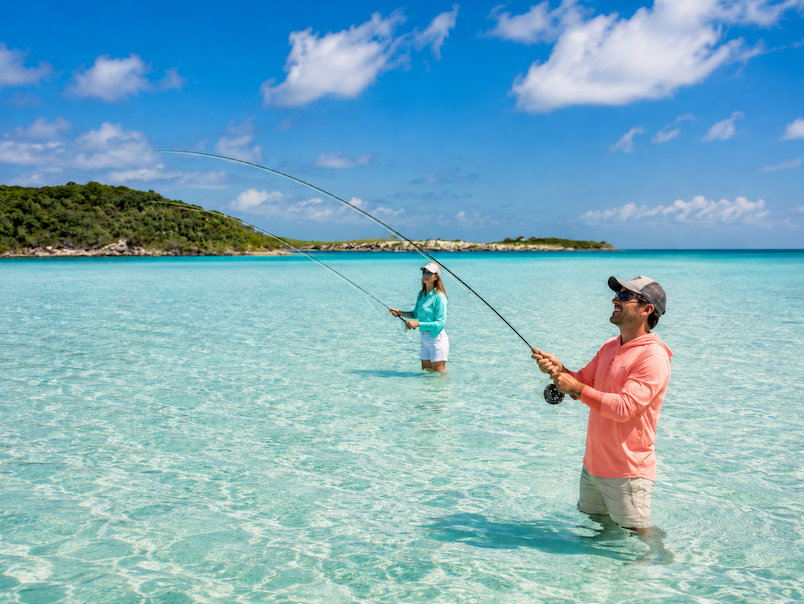
Andros is the largest island in the Bahamas and one of the least visited. Most of its 2,300 square miles is roadless tidal flats, mangrove creeks, and open water. The east coast has a thin strip of small settlements. The west coast has almost nothing except bonefish. That is why Andros has been called the bonefishing capital of the world for decades, and it is not marketing.
What Bonefishing Is
Bonefish (Albula vulpes) inhabit shallow tropical flats, typically one to three feet of water over sand and grass. They are caught and released. What makes them compelling is the combination of difficulty and environment: spotting a bonefish tailing in ankle-deep water, presenting a fly accurately, and watching the fish bolt at 25 miles per hour after the hook sets.
Andros sits on the Great Bahama Bank and is divided by three inland tidal channels, the North, Middle, and South Bights, creating a network of flats extending for hundreds of miles. The west side drops into the Tongue of the Ocean, a deepwater trough falling to more than 6,000 feet within a mile of shore. Along that edge lies the third largest barrier reef in the world. Trophy bonefish on Andros average three to five pounds. Double-digit fish are caught regularly on South Andros, which sees less pressure than the north.
How to Get There
Nassau to Andros is served by Western Air with flights to San Andros, Andros Town, and Congo Town in under 20 minutes. Round-trip airfare runs approximately $80 to $120 USD. Day trip bonefishing from Nassau is possible, as several Andros guides offer packages including the flight, a full day on the flats, and the return for $400 to $600 USD per person. For planning the trip from Nassau, the Best Day Trips from Nassau guide includes Andros alongside other Out Island options.
For a dedicated fishing stay, Bair's Lodge on South Andros is among the most respected operations in the Bahamas, in continuous operation since the 1980s. Multi-day packages start at approximately $2,200 USD per person for three nights and two days of guided fishing.
What a Day on the Flats Looks Like
A guided day begins at sunrise. The guide poles a flat-bottomed skiff silently, engine off and push pole the only sound, while both angler and guide scan for fish. Bonefish are nearly invisible in the shallows. The guide spots them by movement, shadow, and the slight disturbance of tailing fins. The angler casts ahead of the fish and strips the fly slowly.
Most first-time anglers miss fish. The casting angles, wind, and visibility are different from any other fishing experience. Andros guides are among the most skilled in the Caribbean and many come from families that have fished these flats for generations. Best months are March through May and October through November.
Beyond Fishing
The barrier reef on the east coast is among the least-dived in the Bahamas. Small Hope Bay Lodge on North Andros runs a dive operation. The blue holes of Andros, inland sinkholes connected to the cave system under the island, are accessible for snorkeling at points reachable by road. The Blue Holes Bahamas guide covers these formations including Andros in detail. For water activities closer to Nassau, Nassau Water Sports from the Cruise Port covers options without Out Island travel. For park and conservation information on Andros, the Bahamas National Trust manages the West Side National Park on the island.
Practical Notes
Bring polarized sunglasses, essential for spotting fish. Sun protection for a full day on the water requires sunscreen, a sun shirt, and a wide-brim hat. Bring cash, as most Andros lodges and guides work on cash or wire transfer.
FAQ
What makes Andros the bonefishing capital of the world? Vast tidal flats, the third largest barrier reef, and low fishing pressure create conditions producing more and larger bonefish than almost anywhere else on earth.
How do I get from Nassau to Andros? Western Air flies to Andros airstrips in under 20 minutes. Round-trip airfare runs approximately $80 to $120 USD.
Do I need to fly fish? No. Spinning and conventional gear work. Most guides accommodate both.
Best time of year? March through May and October through November.
