
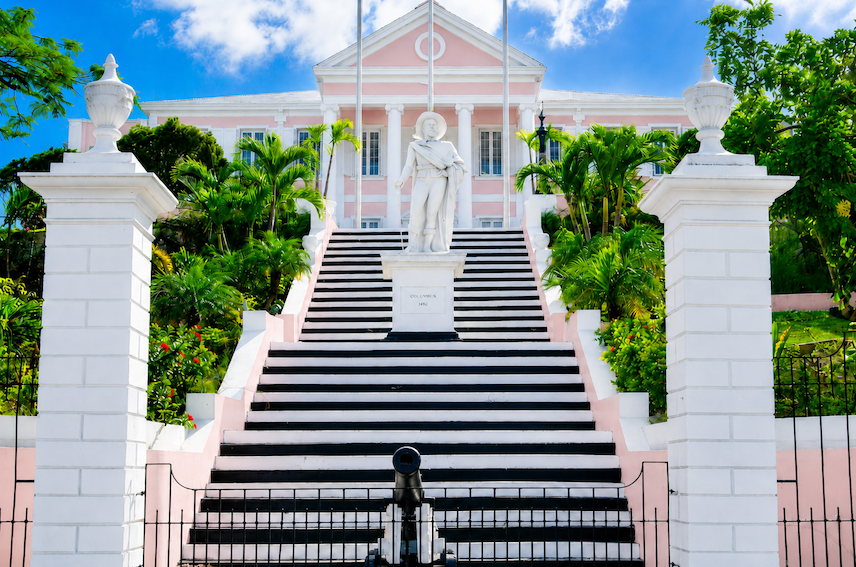
Most visitors notice Nassau’s colors before they understand them. Pink government buildings, white shutters, pale walls, blue sky, and bright Caribbean light all become part of the city’s first impression.
But Nassau’s pastel palette is not just a pretty background. In the historic core, color helps the city tell a larger story about colonial influence, civic life, island adaptation, and the way The Bahamas makes formal spaces feel warmer and more local.
Parliament Square: The Pink Buildings That Anchor Downtown
Parliament Square is one of Nassau’s clearest visual landmarks. Nassau Paradise Island describes it as a group of Colonial-influenced pink buildings in downtown Nassau, originally built in the late 1700s and early 1800s by Loyalists from North Carolina. The square includes the House of Assembly, the Senate Building, and the Supreme Court of The Bahamas.
That makes the color more than decoration. These buildings are part of government life, which means visitors are not only seeing architecture; they are looking at a civic symbol. To understand the deeper background behind this area, connect the visual layer with Nassau’s history.
Government House: Pink, White, and Official
Government House is another major part of Nassau’s color story. The Office of the Governor-General identifies Government House at Mount Fitzwilliam as the offices and residence of the Governor-General. Nassau Paradise Island also describes it as the official residence of the Governor General and one of the foremost examples of Georgian Colonial architecture in The Bahamas.
The building’s pink-and-white look matters because it softens the formality of the architecture. The structure still feels official, but the color, tropical setting, and island light make it unmistakably Nassau.
Why Color Feels Cultural in Nassau
In Nassau, color is part of how public spaces become memorable. Pink buildings, bright façades, white shutters, and sunlit streets are not separate from the city’s identity; they are part of how visitors and locals recognize the place.
That visual identity sits beside other cultural markers. Like Junkanoo in The Bahamas or conch in The Bahamas, Nassau’s colors help shape the way the islands are remembered. The difference is that this story is not performed or served on a plate. It is built into the streets.
The City Beyond the Postcard
The mistake is treating pastel buildings only as photo backdrops. Yes, they photograph beautifully, but they also show how Nassau absorbs outside influence and turns it into something local.
That is visible beyond government buildings too. Around downtown, markets, historic streets, and cultural stops all add to the city’s visual rhythm. A place like the Nassau Straw Market belongs to a different category as a visitor guide, but it also reminds you that Nassau’s identity is built through color, craft, conversation, and street-level life.
Practical Notes
This is not a “best photo spots” guide. For that kind of route-based planning, use a separate visitor guide. The Island Life angle is different: slow down and notice how the city looks and why that visual language matters.
If weather changes your day, a Rainy Day in Nassau plan can still lead you toward museums, heritage buildings, and cultural spaces where Nassau’s visual identity is easier to notice.
What Cruise Passengers Get Wrong
The mistake is walking through downtown Nassau too quickly. Many visitors see the port, a shop, a drink, and the ship. They miss the fact that downtown still carries layers of public life, government, history, and local identity.
The second mistake is assuming color is only decorative. In Nassau, color helps formal places feel warmer and historic places feel alive.
FAQ
Why are some Nassau government buildings pink?
Parliament Square is known for Colonial-influenced pink buildings, and Government House is widely recognized for its pink-and-white appearance.
Is this blog about photo spots?
No. It is about visual culture and island identity, not a photo itinerary.
Which buildings best show Nassau’s pastel architecture?
Parliament Square and Government House are two of the clearest examples.
Does this replace a history guide?
No. It adds a visual layer to the history. For the full background, start with Nassau’s history.
